
Small models. Real decisions.
Small models. Real decisions.
Five familiar games. One question:
how well can a model choose its next move?
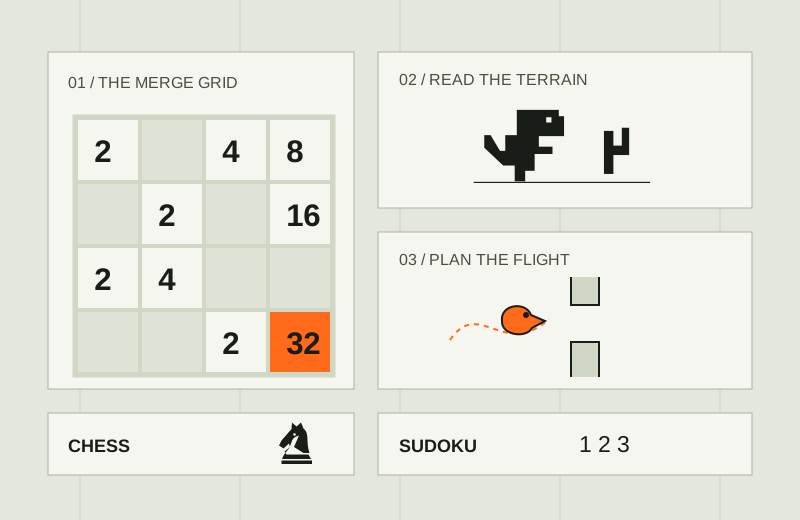
Game state becomes text. A model ranks a small set of actions. The engine makes the next move.
OPEN TO YOUR NEXT IDEA.↗
Same games. Different decisions.
2048
Four directions, a shrinking board, and a corner worth protecting. Models choose among guarded legal moves.
Dino Run
A runner with jump momentum and real collision bounds. Read the terrain, jump over cacti, and duck under birds.
Chess
Two players, full chess rules, and a ranked shortlist of about 14 legal moves. Every benchmark pairing plays both colors.
Flappy Bird
Navigate pipe gaps with real flight physics. Assisted models compare short flight plans and replan after each control.
Sudoku
Forced cells fill automatically. The model handles the next ambiguous digit; three mistakes end the puzzle.

Your game belongs here.
A new environment, a different kind of decision. Help us build the next test.
Suggest a game ↗The interesting part
is the choice.
These are decision experiments, with explicit candidate sets and inspectable context. Scores make more sense when you can see the rules, the assistance, and the baselines behind them.
How the experiment works ↗Describe the stateThe board, nearby obstacles, or the next unresolved cell becomes a short text context.
Choose an actionA shared model backend scores the options supplied by the game.
Measure what happensSeeded runs record scores, variance, coverage, and decision timing.
Bring a model.
Build a game.
Have something worth testing? Suggest it, or follow the integration guide and open a pull request.