
The project
An open playground for small decision models. Familiar games make each choice visible, repeatable, and easier to question.
MODEL ARCADE LAB / OPEN RESEARCH ↗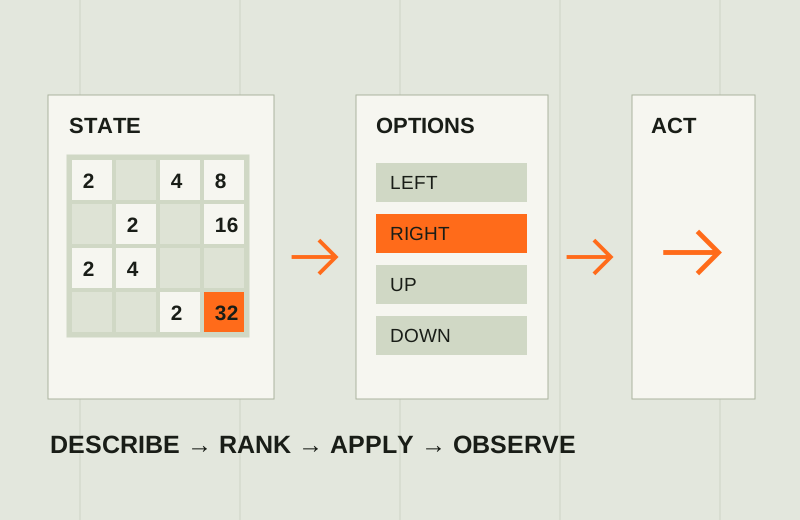
What happens when
a small model plays?
The game describes a situation in text and supplies a set of actions. A decision backend chooses an option, the engine applies it, and the cycle repeats.
The project supports seven backends, from local classifiers to a hosted API. They share one adapter interface; the games provide their own rules, state descriptions, and candidates.
Read the technical README ↗Ground cactus arrives in 2 ticks. Height: 0 · vertical speed: 0 Standing height: 1.8
The model sees the state and candidate descriptions. Game-specific guards may narrow the choices.
Seven backends. A shared question.
API access, and checkpoint permissions.
Laya
Jev-BERTa
Drex
Kev-0.8B
GLiNER2.5-Decide
Bev-Decider-0.4B
DecisionMaster
Your suggestion
Read the conditions.
Then read the ranking.
This is a collection of observable experiments, not a general intelligence ranking. The games use different kinds of help, and a strong result in one setting does not establish ability elsewhere.
Inspect a run ↗Assisted and raw are different experiments
Assisted Dino skips idle ticks and filters immediately fatal controls. Assisted Flappy compares three-tick plans and filters paths using known physics. Raw mode removes those helpers and asks every tick. Baselines use their own policies in either mode.
Other games have guards, too
2048 filters moves to preserve a corner strategy. Chess presents a ranked shortlist of about 14 legal moves. Sudoku fills forced cells automatically, then asks the model about the next ambiguous digit.
Seeds, versions, and sample size matter
CLI comparisons use the same environment seeds for every player, with a separate reproducible stream for random policies. Compare engine versions and control modes separately. Look at spread and seed count rather than a single best score. Legacy runs may lack this metadata.
Overall points can have different coverage
Average-score suites normalize each game relative to its best mean. Versus uses win share; round robin uses points rate. Overall points average only the games a player completed. A player covering one game cannot be directly compared with a player covering all five.
Timing is local to the recorded machine
Decision timing measures the local policy work recorded by the runner. Hardware, model loading, and concurrency affect performance; browser animation delay is not part of the headless decision metric.
Open code.
Inspectable experiments.
The repository contains the game engines, model adapters, benchmark launcher, and browser arcade. This public site reads result files; it does not execute submitted code or run model inference.